Today I had a chat with Sally Taylor a fine art, drawing and contextual studies tutor about my work how my ideas had developed to my concept and how the links to my research.
After seeing my deconstructed suit I explained how I wanted to combine the traditional techniques of tailoring with the rather new pattern cutting method of subtraction cutting. Sally suggest that mixing the two contrasting pattern cutting ideas might not make a balanced garment. She advised that I could alternately create an outfit that combines the methods in a more balanced manner but to still experiment with combining the two methods so see what happens.
We also talked about how I was going to link my future outcomes with my theme of of the Japanese culture. After looking at my research of the folk law tale of the Snow Woman and the different versions I explained that my colour pallet and fabric choices where decided from the one of the version of the tale where the spirt of the snow woman entices travellers to their deaths but spares the some of the young and beautiful. In the the versions of the tale the spirt appears either naked or in a white kimono and from this I want to use white or a pale colour, light weight fabric that is slightly transparent. I want to use a lightweight fabric to represent the flowyness of the snow and a white or pale slightly transparent fabric because of what she is described as wearing/not wearing.
Sally asked me if I had every read Memoirs of a Geisha by Arthur Golden or seen the film and how I could take elements from the story like the the sale of the main character's (Chiyo Sakamoto) "mizuage" - the coming-of-age ceremony for an apprentice Geisha where wealthy buyers to bid on her virginity so the apprentice could become a full Geisha.
In the book Chiyo Sakamoto presents prospective bidders ekubo (a sweetened rice cake) to prospective buyer to signify it is her time for mizuage.
“Mameha went to a confectioner’s shop that same week and ordered on my behalf a kind of sweet-rice cake we call ekubo, which is the Japanese word for dimple. We call them ekubo because they have a dimple in the top with a tiny red circle in the center; some people think they look very suggestive.”
“Please accept these ekubo, Doctor,” I said, and after bowing, placed the package on a side table near his hand.”
Excerpt From: Arthur Golden. “Memoirs of a Geisha.”
I like the idea of models carrying ekubo on the catwalk or in a photography shoot, wearing my garments because it is a strong link to the Japanese culture.
The details of the mizuage ceremony are not in the film so unless people had read the book or knew about the culture the presence of the rice cake would not be understood but I like the idea of the mystery behind this element.
Showing posts with label Unit 1. Show all posts
Showing posts with label Unit 1. Show all posts
Tuesday, 9 December 2014

Thursday, 4 December 2014
Tailored Suit Deconstruction
 After a one to one with Jo concerning what universities I want to apply to and what I would like to do we decided that my work should try and incorporate tailoring into what I am doing now because of me applying for Bespoke Tailoring at London College of Fashion.

 So at lunch I went around some charity shops in town looking for a cheap tailored jacked to use in my work.
I deconstructed the jacket so I can see all the different aspects and pattern pieces that go in to final jacket.
Looking at the suit after experimenting with subtraction cutting technique, the two ways to produce garments are very different; one is very structured and planned where as the other if not vigorously documented may never be able to be created again, making it each garment unique.
I want to try and combine both pattern cutting approaches, either mixing the two ways in a single garment or creating separate garments, each using a different pattern cutting technique for an overall outfit.
Wednesday, 26 November 2014
Experimentation - Subtraction cutting - The 'Tunnel' Technique


Toady I experimented with two techniques of subtraction cutting demonstrated in Julian Roberts' 'Free Cutting'.
He calls the two techniques the 'Tunnel' and the 'Plug' techniques.


The 'Tunnel' Technique
Using any round object to hand (in this case an empty coffee cup) to create the holes to be sewn together internally to create a obscure tunnel for an object, like the body, to travel through.
The first sample I created I only cut two holes in the fabric keeping the fabric flat and with to twisting it to get my head around how it worked.


subtracted more of the fabric and twisted the fabric to see what textures, shapes, the way it drapes
 To best demonstrate how the tunnel technique manipulates fabric is with it on a object or body part. This shows how 'subtracting' fabric and sewing the holes together causes a mass of fabric that falls and drapes naturally. By subtracting the fabric in this way you create lots of interlinked layers from one piece of fabric.
I think small aspects of a garment using this technique, like a sleeve or a collar would give a garment a new edge whereas using this technique in all of a garment might be too over powering for the style of collection I have in mind making the clothing less elegant and I might struggle to reflect my concept that is still developing through my research.
Tuesday, 11 November 2014
Task Three - Research - The Falklore Tale of Yuki-onna (Snow Woman)
After my one to one assessment feed back I've been researching into Japanese traditional folk law tales to draw inspiration for my work from different aspects of the culture then just fashion designers.
 I've come across a tale about the Snow Woman (Yuki-onna). In this version of the tale, Yuki-onna is a sprit of a woman who died in the yearly snow storms in northern province of Echigo.
Yuki-onna appears in Kyuzaemon's (a lonely farmer who's family had passed away) home in the early hours of the morning after asking to be let in and denied. Kyuzaemon realises that the woman is a spirit and becomes very fearful. The sprit explains that she is travelling through the snow to the next village but the wind is against her and needs somewhere to rest before travelling on further. In the morning she is gone and have moved to the next village to haunt the man she was married to before perusing in the snow for leaving her family.
However after further research it there are many revisions of the snow woman tale, most say she encourages travellers in the storms to their deaths but spearing some of the young and beautiful. Some carry on the story saying that when the young and beautiful have grown up she appears again to them and they fall in love.
Some revsions of the tales say that she wears a white kimono, while some say she appears naked in the snow with the palest skin with long jet black hair.
After reading through Richard Gordon Smith's adaptation of the tale and more traditional renditions of the fable the main ideas of the story have given me ideas for my work, such as colour scheme. I could keep my colour scheme very pale, mostly white but maybe with a hint of colour like snow obscuring objects in the distance.
If I decided to document my final outcomes through a fashion film or a photography shoot I could use the setting of the legend as the scene and backdrop hopefully influencing the viewers interpretation.
Wednesday, 29 October 2014
Task Two - Research - Free Cutting by Julian Roberts

While on Pinterest I came across an image of way of pattern cutting manipulation called Subtraction Cutting.
This is a class taught by Julian Roberts a renowed fashion designer and film maker who has show in London Fashion Week several times and the five time winner of the British Fashion Council's New Generation Award.
Many garments are created by flat (traditional) pattern cutting methods or draping fabric over a mannequin.
Substraction Cutting is a method where a hollow construction is developed into the pattern that uses the negative spaces in patterns, turning the usual garment style to a combination of traditional pattern construction and draping producing unique shapes and styles.

After further research into this technique, I can see a link between this method and my theme of Traditional Japan. The draping in the garments produced could represent the folds seen in the art form of origami.
I intend to experiment with this technique after finding this guide produced by Julian Roberts:
http://www.mediafire.com/view/10d8kgbkp1yxc88/FREE-CUTTING-Julian-Roberts.pdf
The guide gives a introduction to the technique and explains how the method works and how to apply it to your own work.
I think subtraction cutting would give my work a new edge that I could link to my theme making my work more successful then using the traditional method of pattern cutting or draping.
Tuesday, 28 October 2014
Task Three - Development - Pattern Idea Proposal
After creating my pervious two illustrations I have had the idea of developing a fabric print using a origami influenced sample and a piece of work I produced in the Fine Art way.

I could combine the textured origami sample and the Gerhard Richter inspired reworked photograph. Using inspiration gained from John Stezaker's work I plan to have parts of the pattern showing through the 'windows' created in the textured fabric sample.
Hopefully the pattern will be obscured by the lines of the folds in the fabric showing a link to how a pattern would be obscured by the folds in origami, for example a traditional Japanese handheld fan when partially closed.

Thursday, 23 October 2014
Task Three - Development - Fashion Illustrations
After my group critique this morning I created these two designs on Illustrator to reflect the feed back was given. I have use the advise of changing the colour pallet and structure of garment to be be more flawy were the pleats and fold fall naturally.
In these two design I have taken inspiration from the designers Yohji Yamamoto and Issey Miyake and their work that I have pinned on my Japanese Inspiration Pinterest board.

The pattern element for these designs came from a photograph I worked on previously in the Fine Art roundabout.
I have left some of the illustration without pattern to shown the layering of the garments. However I really like the patchiness of the pattern adds aestheticly pleasing element to the designs.
Group Critique

Today I put forward the the origami cape I produced a few weeks ago in the group crit.
In the group critiques I was advise to change the colours because pallet reminded some of the group of Halloween. They advised I change the black to white or a softer colour to give a softer effect that would still represent and adhere to the Japanese theme.
A comment was also made about the two contrasting ways the fabric fell; the flow of the cape compared to the structured folding piece on the back. The thoughts from the group was that the contrasting combination of the drape of the fabric didn't work.
The group proposed that the folds in the cape were more subtle and more flattering to the body then the bolder crisp lines in the folded fabric.
The class expressed my own realisation of the fabric choice saying for the folded element of the experimental garment was too thick and a lighter weight fabric would have worked better.
As I carry on my development I think I will use the advise for creating folds in softer way by the drape of fabric rather then the structured approach and change the black for a more feminine colour.
Tuesday, 21 October 2014
Roundabouts - Fine Art - Photos

Today I caught up with the Fine Art pathway where we tasked with appropriating, manipulate and alter 'found' images. We could do this by obscuring the photographs with paint or collaging them together to create new combined images.

 Before we started editing the photos we look at the works of Gerhard Richter, Robert Rauschenberg (who both edited found images using paint and mixed media techniques) and John Stezaker (conceptual artist who combined images to create new).
These are just a few of the photographs I edited inspired by the artists using the medias of paint and varnish and collage.
I admire the the way the varnish and the paint have reacted with each other on the photographs to create textures and patterns.
I think I will experiment with the first image shown to create a pattern for a fabric because the printed textures and pattern would transpire well onto the fabric.
The colour pallet I have used have a Autumn ambiance that would suit a winter/fall fashion collection.
Tuesday, 14 October 2014
Roundabouts - Textiles and Fashion - Manutex Printing

In the forth roundabout session we attended the option Textiles and Fashion. In this session we experimented with mark marking in the form of manutex printing; a form of pattern printing that can only be printed once, unlike most printing making.
When manutex printing you draw your chosen image or pattern onto the silkscreen and pull it through the screen using a print paste on to material.
Rather then print onto cartridge paper I experimented with appropriating fashion magazine images. This wasn't very successful because the paper had been printed on previously meaning that the ink didn't soak in.
Friday, 10 October 2014
Task Three - Development - Textures


In my sketchbook I've been experimenting with stitching in place the folds in fabrics seen in the art of origami.


To develop the idea further I attempted to stitch the folds in a less precise manner to create a different texture.
I then cultivated the idea to create a larger piece of fabric using the same technique for a sample garment to see how the distorted fabric effects the drape and fall when on.

Tuesday, 7 October 2014
Roundabouts - 3D - Wire Structures
This morning we spent some time creating wire structures and drawings using the the spot wielding machine. The outcome of the task was to reproduce a drawing of a primary photographs, objects or drawings.

I selected the paper origami dress I constructed in a past exercise for my inspiration. Looking at a small area of the front bodice I experimented in reproduce the folds into 2D wire drawing.

To develop the wire drawing example further I created a collage using the sample to loosely show the idea of how wire could be used as a garment material.
Tuesday, 30 September 2014
Roundabouts - Photography - Light Painting
This afternoon the group were given the task to create a selection of photography images expiring the technique of painting with light.
After the group session the photos were sadly lost.
However, last year I completed the UAL Diploma in Photography as a night course where were experimented with this technique so I am able to show past work I have produced.


For the first image I experimented with the a static light and a moving model to create an abstract laying effect that gave the image a eerie, sinister aesthetic.
In the second image I have use a traditional technique where the light source moves rather the the model. However I used a additional light source to cast a shadow on the face to add to the atheistic.
In the second image I have use a traditional technique where the light source moves rather the the model. However I used a additional light source to cast a shadow on the face to add to the atheistic.
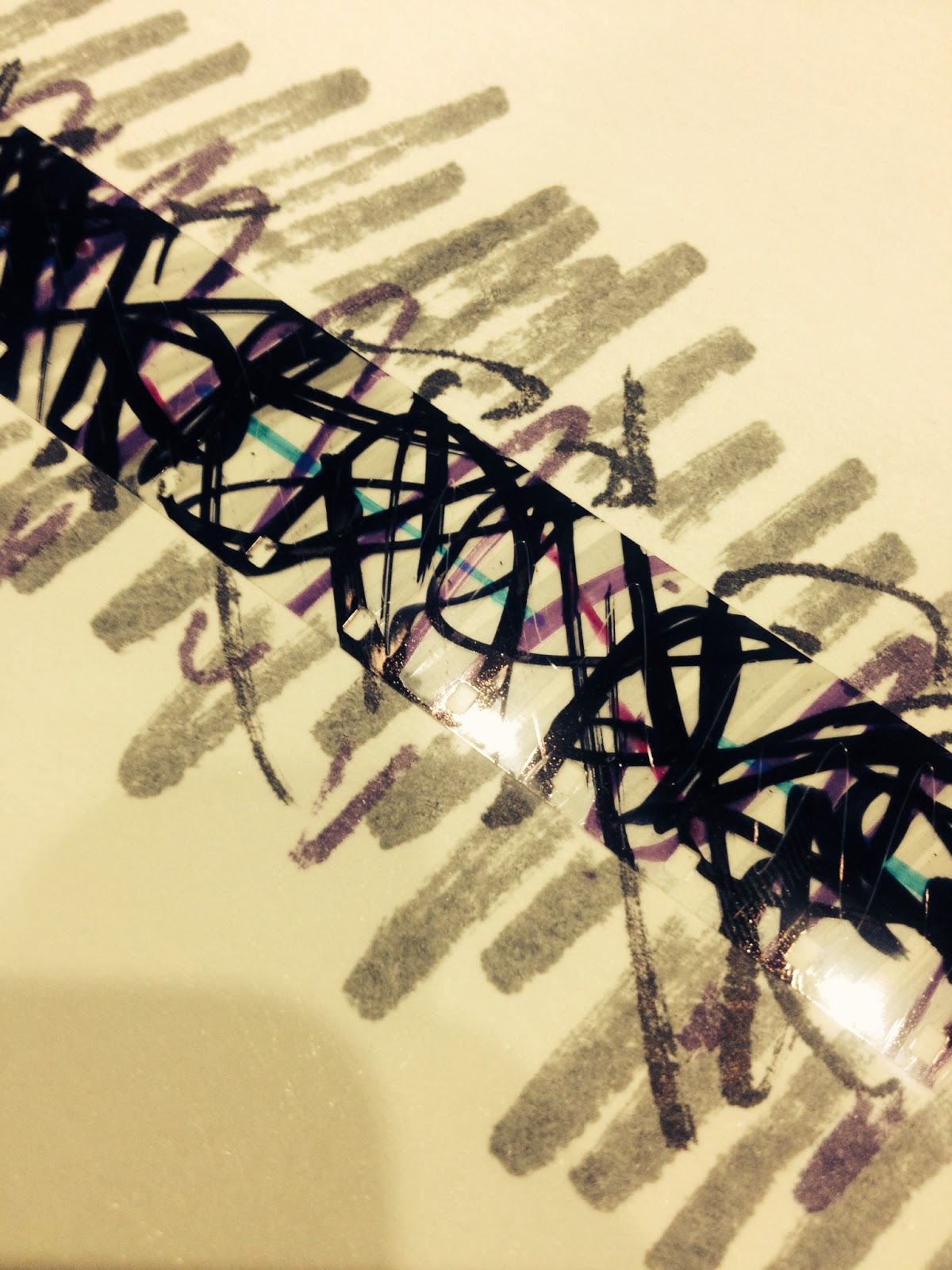
Roundabouts - Media - Scratch Film
This morning we started the roundabouts where we try each examples of work that can be made in each different pathway.


This morning we began with the Media pathway, where we created a scratch film.
The group were shown examples of scratch films from the early to mid 20th century such as:
Stan Brakhage's Mothlight

 Len Lye's Kaleidoscope
The group were shown examples of scratch films from the early to mid 20th century such as:
Stan Brakhage's Mothlight
Len Lye's Kaleidoscope
After viewing the films we were tasked with making our own version. Each person in the group were given four seconds worth of 16mm film.
For my four seconds I worked straight onto the film using permanent markers in a imprecise manner to give a contrast to the more structured seconds that my piers created.
For my four seconds I worked straight onto the film using permanent markers in a imprecise manner to give a contrast to the more structured seconds that my piers created.
Friday, 26 September 2014
Dolphinholme Residential - Photographs


 Using a mirco-lense I took close ups of the tiny bottles, changing the aperture, shutter speed, ISO and light settings to change the aesthetic of the images.
Thursday, 18 September 2014
Creativity Exercise - Build - Part 2 and Group Critique


This morning we spent a little more time on the creativity exercise called Build.
To develop my paper garment I decided to create a skirt to reflect the style of the bodice. Using the same materials folded in a complimentary fashion I made the bottom half of the garment, however joining and overlapping in a different way to the bodice.


 After lunch we had our first group critique of the year, where students could opt to show what they had built and receive feedback from the others on their work.
I chose to show my work to gain influences and ideas from other people's opinions of my work. I received comments such as "the garment has a futuristic style, through the use of folding and sharp edges" and how the shape of the bodice reminded some of the group of a bird with the folds representing feathers.
The group had a discussion about the the use a pattern material if I was to take this way of Origami garment construction forward. After some deliberation it was decided that a pattern material would take away the sharpness of the folds and that the shadows cast by the folds gave the garment its own pattern.
I was questioned on the length of the garment and why I chose it to be at that length. I was restricted to the size of the paper rather than having the option of length. When making the skirt I created it the same way circle skirts are made but using a square rather then a circle for the hemline.
I was also asked what fabric I would use if I chose to move on from using paper. Using my knowledge of fabric and the qualities each possess, I explained that it would have to be a fabric such cotton calico strengthened by interfacing because it would hold the fold lines without being weighed down. I could also use a synthetic material such as strengthened polyester because some the the characterises of the fabric are similar to cotton but polyester doesn't breathe and if the garment was to be worn it wouldn't be very comfortable and polyester can have a 'cheap' look that is undesirable. Mouldable fabrics such as wool and felt could be used but I would have to experiment to find a way to mould the fabric to create appropriate folds for the garment.
Wednesday, 10 September 2014
Hand Print, Hunting and Being Human Lecture
The group (Foundation Pre-dregree) attended a lecture titled Hand Print, Hunting and Being Human. The subtext of lecture was; what is art?
We were presented with two images of the Lascaux Cave.
Gaining an understand of the paintings will help in answering that question.

From the very beginning of the human species as we know it, there has been a need to say we are here, we lived. This is represented in the hand painting in the cave. This is the people who lived thousands of years ago making their mark on the world because they know that one day they won't be there and they didn't want to be forgotten. This could be seen as the first self portrait.

The second image depicts a hunting scene. This could be seen as documenting where I am - a landscape. The hand print art says 'I was here', the hunting scene could connote 'what I am doing'.
By contrasting the two different view points about art one can propose the theory answering the question 'what is art?'.
That the majority of art is a way of documenting who you are and what you are doing, a way of leaving a mark on the world that you don't have to understand. Humans are the only species that do this and art can be classified into two groups; the hand print (portrait - who I am) and the hunting scene (landscape - where I am).
Using the theory when considering the manuscripts exhibited in Blackburn Museum, the art work would be classified as the hunting scene as it is documentation of what was happening at the time.
Individual fashion would be categorised as the hand print. Fashion is a way of expressing yourself, emotions and views. What you wear becomes part of you, communicating messages about your identity.
However cultural fashion would be identified as the hunting scene in the way it is a recording of social standing, ethnical differences and influences of social-cultural changes.
Friday, 5 September 2014
Task 2 - Research - Limi Feu


Daughter of the award winning and influential Japanese fashion designer Yohji Yamamoto, Limi Feu has followed her father's foot steps into the fashion world.
However her choice "LIMIfue" as her design label after coming across the word fue in a French dictionary, suggesting she wanted to make it on her own then rather off her fathers already established label.
Starting her label in 2000, she showcased her work from 2000 to 2007 in Tokyo Fashion week before making her Paris debut in October 2007's Paris Fashion week and breaking into the western fashion world with great praise from critics.
Her designs have characteristics of a darker colour pallet, use of layers, large volumes and asymmetry, a clear influence of her father's designs. However, where Yohji Yamamoto's design are typically more romantic, Limi Feu's are a little more street wear inspired with a rock attitude ambience to her clothing.


These images are of her latest collection Autumn/Winter 2014-2015 from:
Subscribe to:
Posts (Atom)